Travel

Place of Many Wonders, A Day in My Shoes at the American Museum of Natural History

On my last visit to the American Museum of Natural History, a year and a half ago, I arrived at the Hall of Ocean Life just as the security staff was closing it to the public to set up for a private event. So much for saving the best for last, I’d thought, feeling disappointed. This time around, I made sure to make it my first priority.


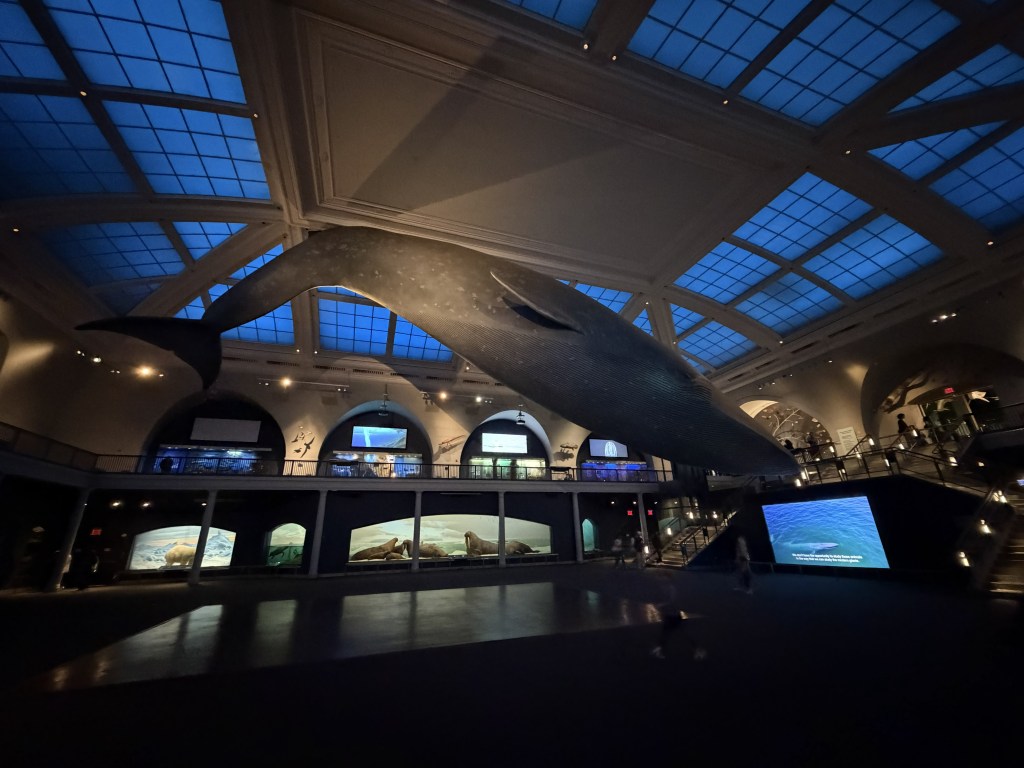
I stroll along the mezzanine level of the gallery, my boots silent on the carpet, taking a good long look at my old friend, the big blue whale. Suspended from the arched ceiling in simulated mid-swim, this giant will never fail to impress me. A bench beneath a model of a, relatively, small squid with razor-sharp tentacles beckons me toward it. I oblige, already sure my feet will be giving me hassle by the time the day’s exploring is through. That’s what poor planning will do though, what coming on a whim to a sprawling museum in New York City in inappropriate shoes will do, that is.
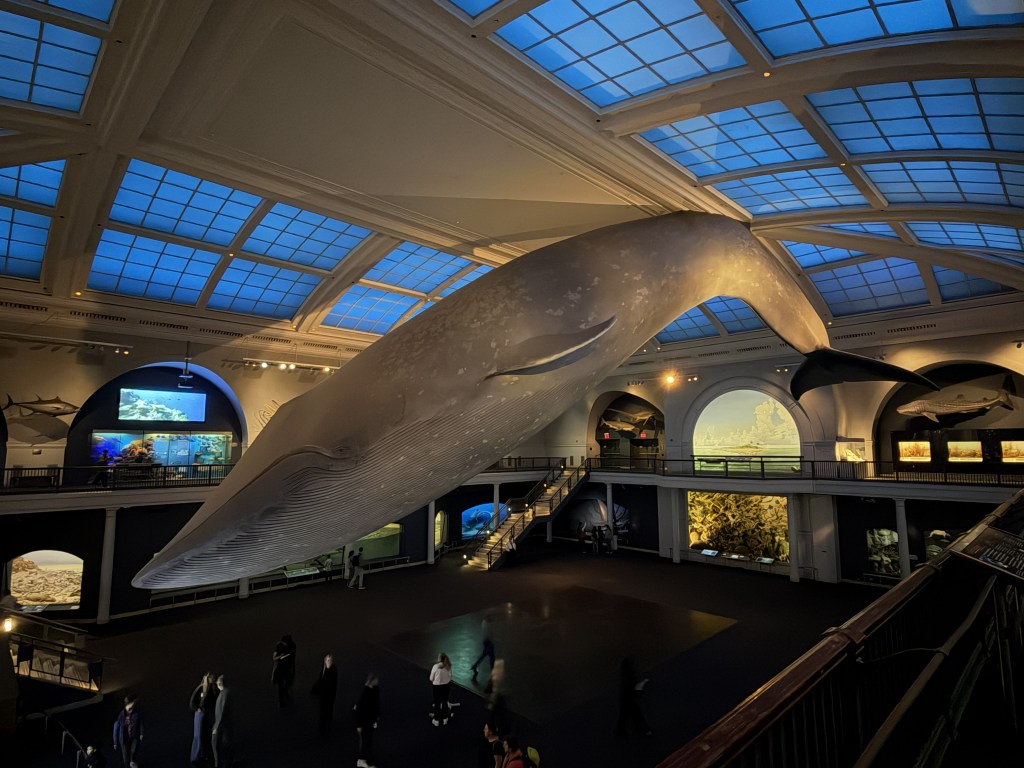
I take my time sitting here on the squid’s bench, with the whale for company. I make wary eye contact, my imagination immersing us both in the ocean with the help of the muted lighting and the adventurous soundscape emanating from the speakers nearby. You look tired today old friend, I think, but maybe I’m just projecting.

A mom walks past with her little kids. “Ooh, look at the jellyfish!” she says to her daughter.

To be small and full of imagination in such a place of many wonders as this one. One of life’s greatest adventures, to be sure.

I abandon my bench after a while and visit the Antarctic Ocean Bottom diorama nearby which houses the aforementioned jellyfish, which is enormous. I read that due to the extreme cold temperatures and slower metabolisms, creatures living in this environment can grow to be many times larger and live many times longer than their warm water counter parts. For instance, a sea spider which may be invisible to the naked eye in a coral reef environment, could be the size of a dinner plate in Antarctic waters. Fun.

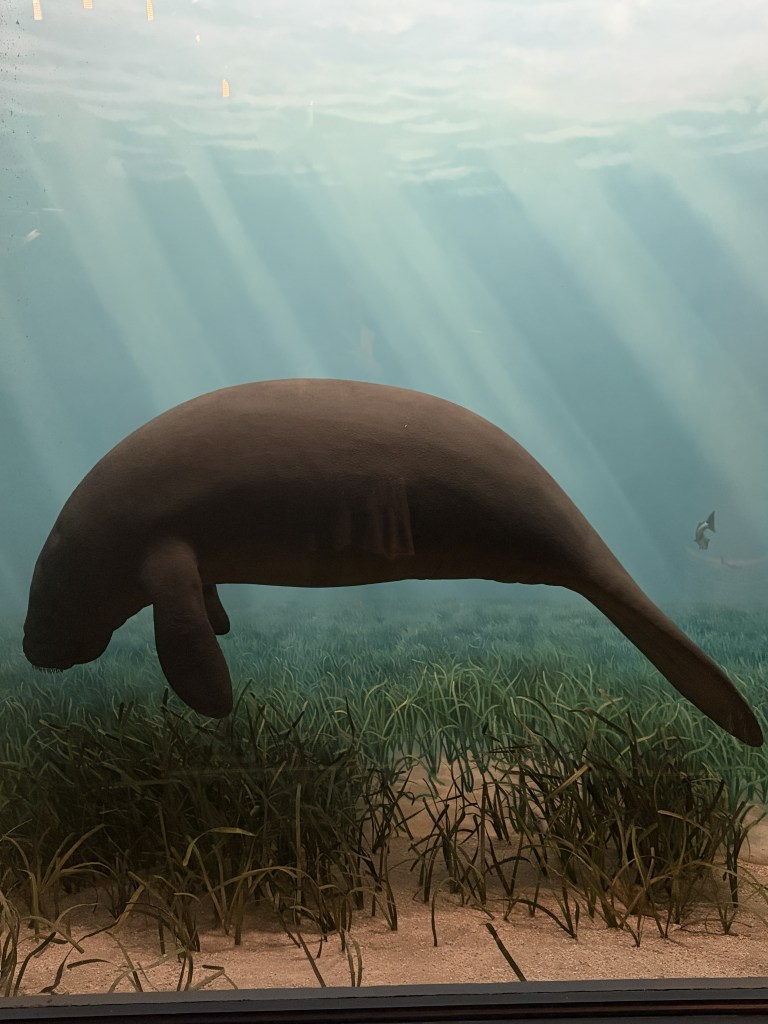
My eyes dart to Big Blue every couple of minutes. My mission is to take my time with the place on this visit. I complete the mezzanine loop and head down the stairs to the lower gallery. The manatee draws me in, my spirit animal, as Mike and I have joked in the past.
I pause at each display on my way to join a small crowd that has formed in the back corner, where a museum staff member is shining a flashlight on a dark, glassless display case. The Squid and the Whale. The scene portrays a fight to the death in the dark depths of the ocean. I’m happy not to have to stand here by myself.

Before heading onto my next stop, which is yet to be determined, a video on a large screen grabs my attention. It is about blue whales and how these creatures, the most massive animals living on the planet today, are able to thrive because of their efficiency in feeding. I learn that the lines on the creatures throat mark an expandable pouch that they fill with water and prey as they swim, unable to take another mouthful until the water filters out and they have swallowed back their meal. I wouldn’t want to find myself too near one in the ocean, I decide. With one last wary look, I move on.
I’m working my way up to facing a particular display case in the Hall of Biodiversity, but I’m not ready just yet. Instead, I wander past the magnified Life of the Forest Floor display that used to terrify me as a kid with its giant millipede, daddy long legs, and ant, each enlarged to 24 times their natural size, and into The North American Forests permanent exhibit. This one has never really captivated my attention until now. There’s a first time for everything though.

I explore the intricate forest dioramas, sweeping my gaze between the tree trunks, the wild brush and along the forest floor, up into the branches that hide little elusive creatures, and to the painted backdrops beyond. I take a seat on a wooden bench beside a diorama depicting a Northern Spruce and Fir environment, a safe distance from a mosquito that is attempting to rival the creatures in the Antarctic Ocean Bottom case in its enormity.

Sitting here, among the trees, I feel a sense of calm. I look up and spot a marten in the branches and remember a Scottish Highlands episode of Escape to the Country which I’ve watched more times than is socially acceptable probably. I am living in my head and I am at peace with it.

I wind through the rest of the exhibit. Two women are reading half of a plaque that pertains to a gargantuan slice of a Giant Sequoia’s trunk on display.

“This tree is a thousand years old,” one says with awe, “Amazing.”

I read the plaque when they are gone and two more women come up.

“It’s all about the rings,” says one to the other. She’s out of breath from rushing about.

Circle, circle, circle. Tap, tap, says her finger decisively on the picture on the plaque before she darts on to whatever she plans to breeze through next, not noticing that encased along with the description of the sequoia is a slice of a much smaller tree trunk that was 1500 years old when it was cut.

I decide the meteorite room doesn’t have the same nostalgia pull for me since the museum redid it, changing the fun, carpeted stair pit that once was a makeshift playground in my childhood to a more refined gallery space befitting of the bright gems it houses within. It can wait till next time, I think.

There’s a more pressing matter at hand for now. It’s time to face a big fear of mine… in the wimpiest way I can think of.

On my last visit to the museum, as I looked among the massive backlit wall of shadowbox displays of crabs, lobsters, and insects in the Hall of Biodiversity, I should have expected the spiders. As soon as my eyes processed what they were seeing, imposing hairy creatures the size of my hands, girthy bulbous bodies sprouting with legs and fuzzy pincers, I could hear my pulse in my ears, feel the pounding in my chest, the sweat dampening my hairline at the back of my neck. I felt the static heat of irrational panic and hurried away.

Not this time.

Guarded by a full-sized tiger for protection, I look from far away at first, shortening the distance little by little until I am about three feet away from the case. I do not look away this time. I focus on my breathing. I read the plaque on chelicerates and am interested to learn that horseshoe crabs, a creature of which I have no fear, are more closely related to spiders than to crabs. I imagine how I’d feel if the hand-sized spiders were moving and my heartbeat quickens.

This DIY exposure therapy is necessary in my mind as my phobia is threatening to keep me from experiencing an important life experience, the upcoming wedding of two friends in South America where there is a non-zero chance of seeing a spider of substantial size. There is a much greater chance of me not being able to sleep due to my irrational fear, both during the trip and leading up to it, so I need to learn to face this before it potentially gets worse.

I leave the spiders when I am ready to move on, pleased enough for now with my brain’s ability to prevent itself from overriding my nervous system to the point of complete uselessness. I remind myself that allowing fear to dictate life can lead to missing out on experiences that enrich and enhance it. I’ve decided I’m not willing to let fear rob me of living fully, of living well.

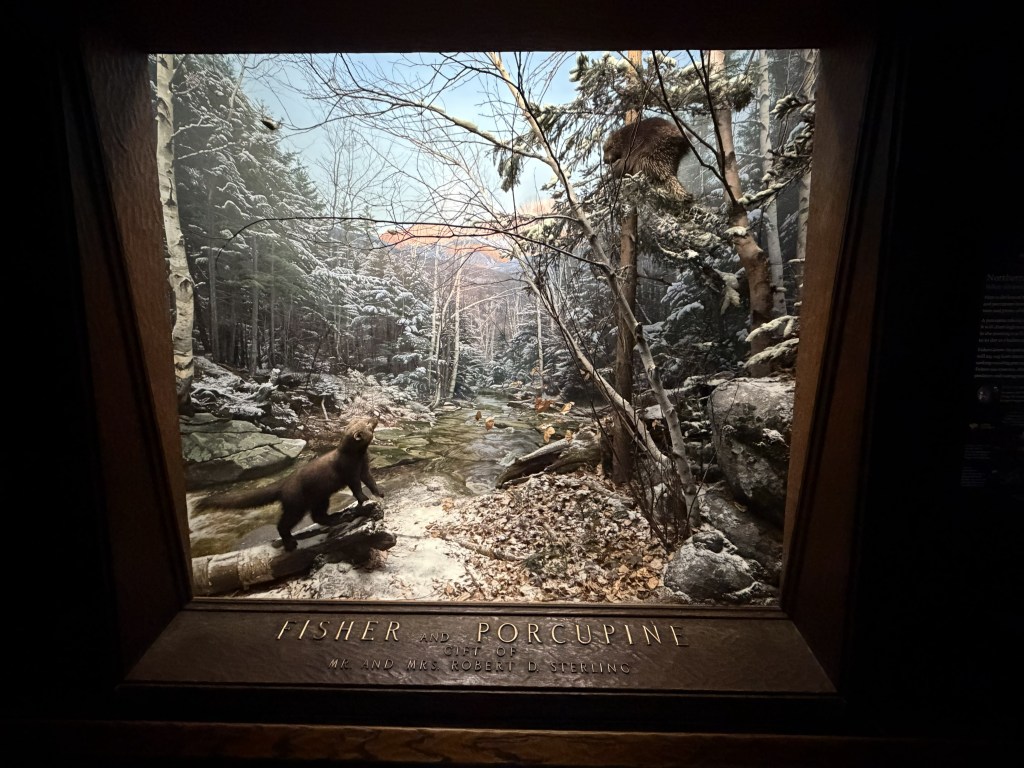
The North American Mammals exhibit calls me next. The wolves and the brown bears, the grizzlies, and the buffalo. I pause by the diorama titled Fisher and Porcupine, recalling the time this summer when Mike and I saw a family of fishers while hiking the Mt. Tammany trail. The plaque tells me that the porcupine is the fisher’s favorite meal. Seems like it’s probably an acquired taste.
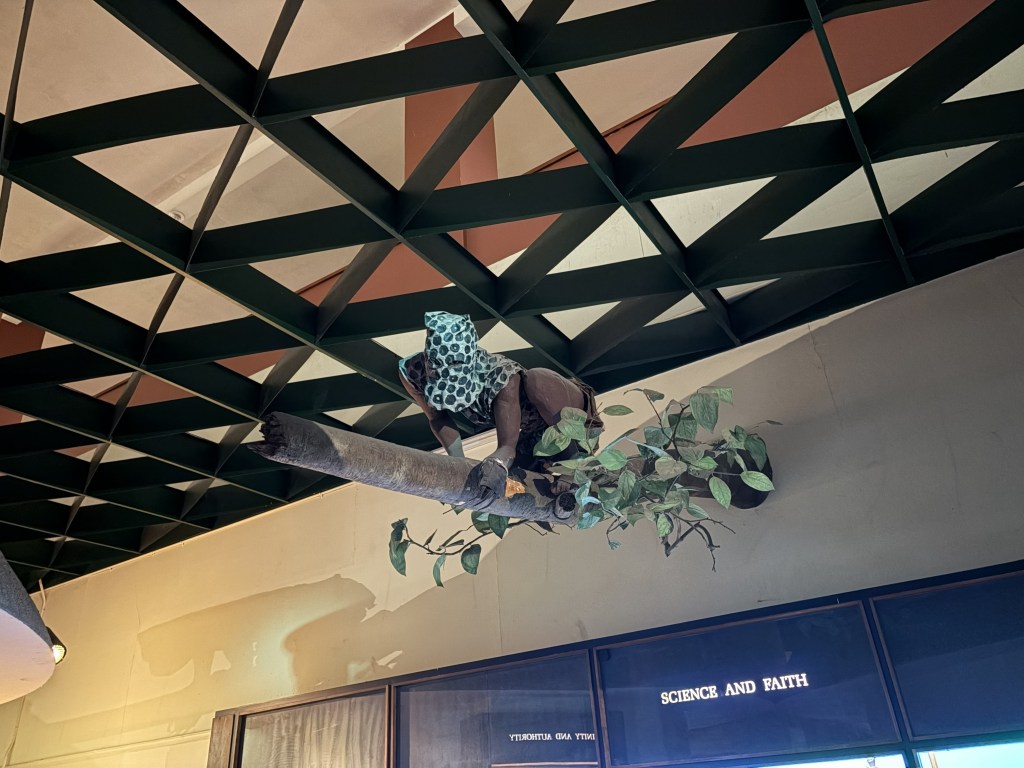
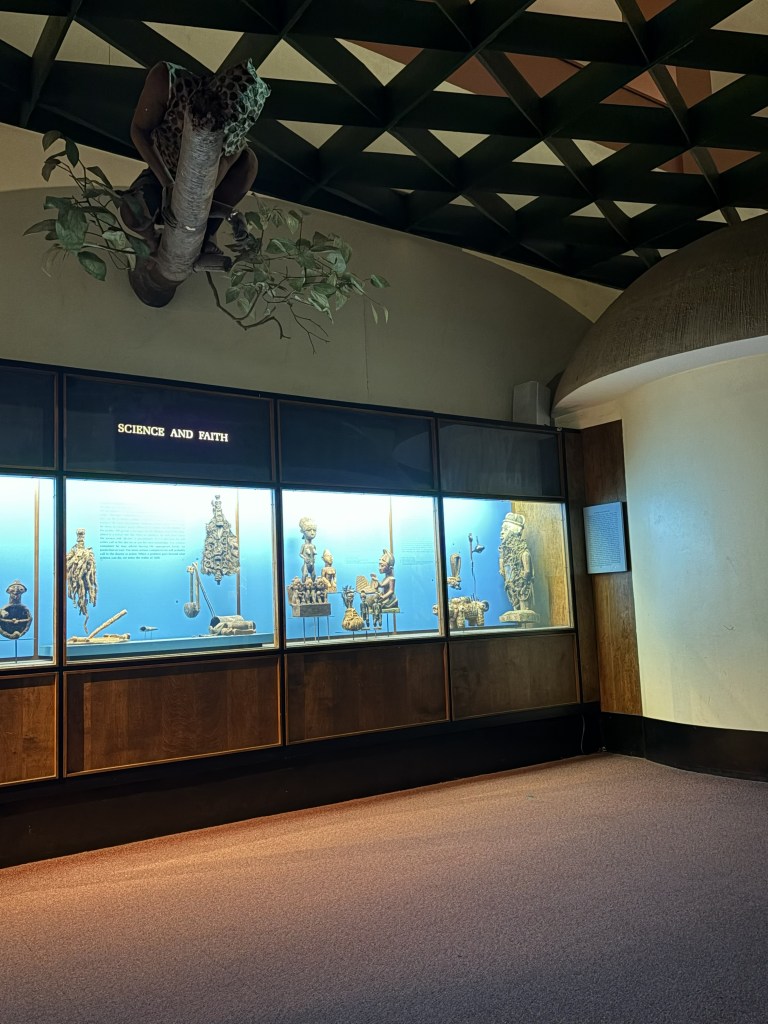
I wander upstairs to the Hall of African Peoples to face a former fear that I have already overcome. My feet aren’t aching yet, but I park myself on a bench near a case entitled Science and Faith. People come and go from this dark little alcove of the exhibit, glancing at the glass case of artifacts with half interest before moving on. I watch them as they do not think to look up, where, just above their heads is a life-sized diorama of a man in a trance, perched on the limb of a tree, his face shrouded in the skin of a leopard, the whites of his eyes shining through, as he fixes his perpetual sights on his unsuspecting prey, below.

I first noticed The Leopard Man on a visit to the museum in my early twenties. I had been to the museum multiple times before on trips with my family or school or summer camp. Never before had the man perched on the limb caught my attention. When he finally did, it scared the Hell out of me.
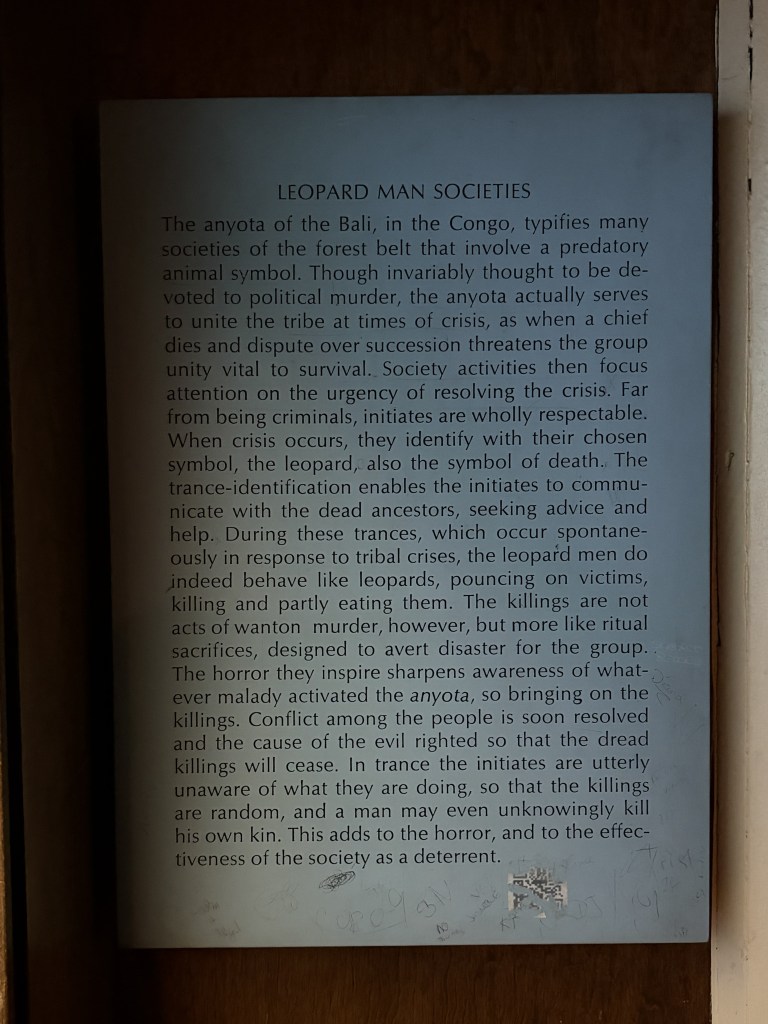
Reading the Leopard Man Societies information plaque on the wall offers no comfort. To summarize the description on the plaque, the practice of Leopard Man Societies was born in response to times of tribal crisis. The members of this secret, esteemed, anyota (Leopard Society) would enter into dissociative trances as a means of communicating with the spirits of their ancestors for guidance. During these trances, they would adopt the behavior of leopards, an animal representative of death in the community of the Baali people of the Congo, attacking random victims from above and cannibalizing them as a ritual sacrifice to ward off conflict and avert disaster for the tribe.
As I sit on my bench, I wonder if any of the passing visitors will look up, but no one does. On my previous visit, a few women had parked their strollers beneath this diorama and tried to soothe and shush their babies as the babies wailed. They were completely unaware of the predator perched just above.
I bid farewell to The Leopard Man and continue on, following my intuition as it guides me up to the third floor and down a bare corridor to the Hall of Pacific Peoples. I pause briefly on my way in to listen to Barbara Walters singing the praises on a small screen of someone named Margaret Mead before perusing the exhibit.

The speakers in this exhibit pump out a soundscape of instruments and songs traditional of various rural communities in the Pacific Islands. I attempt to read a plaque beside a replica of an Easter Island Moai statue’s head, but there is a clump of people waiting to take pictures with the statue so I can’t get close enough. I loop around the back of the Moai and stop by a case on the other side, recognizing a black and white photo that was shown in the video on the small screen at the entrance to the exhibit. Margaret Mead as a budding anthropologist on her first field visit to Samoa in 1926, clad in traditional ceremonial dress.

I decide I am fascinated by this twenty-three year old anthropologist’s determination to travel to Samoa in 1925 and observe of the lives of its people for the purpose of better understanding Americans’ place within their own culture when it came to child rearing and young adult advancement. I pull up my library app and request three books to read more about her life and her wave-making first study, Coming of Age in Samoa.

I watch the whole video on Margaret Mead before heading out of the exhibit, but I do not leave her behind. She is going to be the primary source of resonance from my day’s adventure, I can already tell.

I backtrack to the Mexico and Central America exhibit, then the South American Peoples exhibit. My feet are aching and my steps have slowed. I have been here for over two hours, about my usual museum quota for a day.

The park is whispering through the walls from across the street, with its collection of meandering paths, towering trees, birds, lakes, explorers and inviting reading benches.

I wind my way back to The Rotunda and take a last look at the towering Barosaurus skeleton replica on display before heading out into the sunshine and across the street to Central Park where the trees and the animals are living, where the people-watching is abundant and accessible, and where the air feels as fresh as it gets in the city that never sleeps.

I leave behind the fossils and the dioramas, the Moai and The Leopard Man, the spiders and the big blue whale, carrying only intrigue of Margaret Mead and her adventurous spirit with me as my sole souvenir from my day’s adventure in the place of many wonders.

Cozy Posts · Nostalgic Posts · Travel

Thank You, New York City

New York City on a sweltering evening evokes a sense of truth and camaraderie that isn’t always evident in the city’s boroughs. In the heat, the city’s truest self emerges from its facade of splendor and grit, too warm to layer on the wanderlust a minute longer. It cranks up the AC, adopts a loose, languid appearance that is just enough to scrape by as presentable, and just tries to find the breathable oxygen amid the auto exhaust and amalgam of aromas and stenches permeating the air. Top notch cooking scents waft out of restaurant after restaurant on 9th Ave, quickly melding with baked trash at the curb, only to be sweetened by a hint of perfume speed walking past or a trail of wholesome sunscreen fumes.

As the city sweats, its residents pour outside and sweat with it. They plod the radiating sidewalks to and from work, home, and leisure activities. They dodge steam vents on street corners, waiting off the curb to cross before the walk sign illuminates. They’re wary of darting critters on garbage collection eve as the rooftops across the Hudson tug the sun lower and lower.

Last night, I went in to meet some friends for dinner and, having arrived early, took to winding my way through Hell’s Kitchen in the heat. It was ninety-four degrees and felt over a hundred on the long stretches between avenues where the cross-breezes were blocked by neat rows of buildings.

I popped into Deacon Brodie’s tavern on restaurant row to cool down in the dark and ordered a crispy, cold Modelo which I sipped as I tried not to puddle too much on the leather-upholstered bench where I sat. As my brain simmered, the understanding dawned on me that everyone seated in the bar had most certainly walked in drenched as well and after that, I melted freely and unnoticed.

My brain wandered through memories of past summer days and nights on auto-pilot as it used to when I lived in Brooklyn, navigating by the internal compass that every New York resident develops in order to get by. North, South, East, West. Uptown, Downtown, Brooklyn, Manhattan, etc. It’s the kind of auto-pilot that used to get me to the L platform after work in the heat of July and August without remembering the two-street-spanning underground walk from the 1. Most of my attention usually went into wondering what the real-feel temperature was in the station. 110F? 120F? In the words of my late nana, “Does anybody have a meat thermometer? I want to know when I’m done.”

The nostalgia was strong yesterday as I cooled down in what looked like a miniature version of our old local, Harefield Road, which we decided was still our local when we moved about a mile away from it back when we still lived in Brooklyn. We did that because, in a city as everchanging as New York, if you don’t treasure the things you love, they tend to disappear. In our experience, after too long, doors that once opened to a place that made the city feel more like home, were found chained or covered with paper, sometimes pasted with orange tax evasion signs, or sometimes with a note from the former owners thanking their loyal customers for a good run.

I shook the nostalgia from mind as my friend Katherine walked in, showing she’d gotten my text about being early and where I’d decided to wait out the time till dinner. Katherine is one of a few very good friends who stuck from my time working in New York in my twenties. When I moved to New York, I felt a strong need to make friends of my own, as grateful as I was for Mike and the people who I saw as “his friends” at the time, though they are mine too now. The most obvious place to make friends was through work.

My process was to throw my personality at the wall (the wall being co-workers and acquaintances) and see what stuck. As the years have gone on, I am sad to be on the other side of learning that some friendships don’t stick like others. Whether it’s a general lack of initiative to coordinate or attend that happy hour or draft that text or email, or fail to get a regular catch-up going, friendships end up slipping through the cracks. I often wonder how friends, who I haven’t seen in a while, are doing. I try not to wonder if they’d still classify me as a friend or if they have a metaphorical sign posted on a metaphorical locked door somewhere. Thank you. We had a good run. I’ve grown up a little every year and with growth comes understanding, be it bitter or sweet. I can walk away with memories of good times past, content enough.

I am especially grateful for the sticky friendships though, the people who willingly catch up with me regularly, who care to know what I’m up to, what I’m struggling with, and what’s going well. They bolster and share their own experiences and goals and I am happy to be part of that. From talking to people among my New York circle over the years, a sense of isolation and overwhelm seems to be a common experience for the city’s new arrivals. I am happy to have overcome that in my own experience and to be someone who helps fill out other people’s New York community.

Analisa filtered in next and we headed around the corner to dinner at Elephant Ear and were seated, acceptable enough in our stickiness, that all too familiar residue of New York City heat and pondered the spiciness of the Thai menu items as we waited for our cold drinks.

Ashley came last and the gang was back together again, giving the latest updates for the month, not needing to do the whole “So, what’s new with you?” opener because we’ve seen each other recently enough to have that bit covered. The thing that was new, however, was the temperature, the drastic transition from the east coast’s bitter winter to an abbreviated spring, only to be thrust into August in the middle of May. Oh goodness gracious me.

After dinner, we parted ways and I headed to Bryant Park to meet up with Mike. I entered on the corner of 42nd and 6th and suddenly felt like I was in my twenties again. The lawn was dotted with people sitting on picnic blankets, hoodies, and beach towels. The cafe tables lining the gravel path around the grass were occupied with friends chatting and lounging in the slightly cooled after-dark temperatures. Readers were immersed in their books which lay open on their laps or in the grass. And patrons of the outdoor bars sipped, snacked, and conversated.

Bryant Park Lawn

A hot evening in Bryant Park is a guaranteed time machine for me back to fond memories of my early days in the city. Meandering the paths with Mike. Listening to a live band playing. Strategists taking chess too seriously. The library, up-lit and impressive, sheathing its collection of knowledge, history, and adventure within. When the heat becomes more palatable after sunset, you can’t help but love such a place. At least, that’s how it is for me.

If you ever get to experience the magic yourself, I hope you won’t take it for granted. Just sweat and let your mind unwind. You can’t fight the grimy residue and really, it’s part of the experience anyway. Only when you are seasoned with salt and damp with sweat do you become part of the tableau for everyone else, worthy of such a unifying experience with the people around you, the New Yorkers who call the city home and the visitors who spend their time and money to make the trip there happen, perhaps only once in their lifetime.

So, this one’s for New York in the heat, for the loveable beast of a city that I once called home. For the place that pulls on my heartstrings in moments when I least expect it. For the place that reminds me how who I was and where I lived helped to make me the person that I’ve become. So, thank you, New York City. We had a good run.

Health & Lifestyle · Nostalgic Posts

Drawings in the In-between

I used to walk between the L and the 1 train via the F, M platform in the 6th Ave/14th street subway transfer passage every weekday morning on my way to work from Williamsburg to the West Side. It was routine – automatic and got me from 6th Ave to 7th Ave to catch my connection. Most of the time, I was too lost in the realm of daydreams or looking forward to getting back to reading my novel to pay much attention to my fellow sardines on the conveyor belt of dress shoes plodding along grimy concrete tiles. One day, however, I found myself paying attention by accident, while looking at the ankles of the person walking in front of me, noticing I was seeing those ankles not as skin-covered tendons, muscles, and bones, but as black and white sketched pencil lines on drawing paper. Strange. Cool.

Fascinated, I tried to pencil sketch the rest of my view of the person attached to those ankles in my head on my three minute walk through the in-between, but it was hard to get beyond the ankles with them walking so quickly. On my way home, I did it again, walking the pass-through from the 1 to the F, M platform to the L. I continued to notice peoples’ ankles on my commute on multiple random occasions, each time, not even noticing I was doing it at first, like automatic flip books of pencil sketched ankles and heels walking along the in-between pavers in real ballet flats, loafers, heels, oxfords, and flip flops.

This subconscious turned conscious phenomenon started happening after I attended a few life drawing workshops in the city through the Drawing America program. I had been missing the mindless exercise of timed drawing, the translation of reality to art, the feel of good posture and soft 2B pencil on drawing paper. Looking at the model as lines and shading is a learned, turned automatic skill from my art training in college. I miss the feel of making art in a studio a lot lately. Creative spaces really do fuel creativity.

Lately, I feel like I could cover the walls in tubes and tubes of paint with no rhyme or reason other than because it would be pure fun.

I guess I’d prefer the world to be art sometimes. I certainly seemed to on my city commute all those times through the in-between. It made the gray world more beautiful and animated, more strange and interesting. A brain that thinks in art can catch you off guard in the best way and I entertain it every time I notice it happening and let my imagination run wild like a Mummer through a convent.

I haven’t drawn pencil ankles in the real world in a long time, but I have translated memories into words and to me, that’s sort of the same feeling, if that makes any sort of sense. Even if it doesn’t, don’t worry. Sometimes things you can’t explain or understand can be the most beautiful. Documented murals of letters, words, punctuation, mixed in with me like paint with plaster, presented in a forum for the open minded. Am I art? Perhaps. The reviews are mixed, but I’ll always have the pencil ankles in the in-between, propelling me toward creative pursuit.

Health & Lifestyle · Movies · Nostalgic Posts · Reviews & Reflections

Empty Venues

When I was fifteen, I had the honor of being invited to attend my twin friends’ extravagant sixteenth birthday celebration in New York City. My friends had chosen to take a group of us out to a nice dinner and a Broadway show and afterwards, we all had a slumber party at the Waldorf Astoria. We snacked on decadent Godiva, chocolate-covered strawberries and Twizzlers from Walgreens and once we were all sugared up, we wandered the halls of the historic hotel in search of adventure, movie filming locations, and a ghost girl with a red balloon.

We never did find the ghost girl, but we rode the elevators like John Cusack and Kate Beckinsale in Serendipity (2001) and roamed the glamorous lobby in our hotel slippers and pajamas. I remember wandering into the empty Grand Ballroom, a cavernous hall with box seating all around the walls and a massive, glittering, chandelier overhead, illuminating the room in a dimmed glow.

We walked up onto the stage and looked out at the room, each with a feeling that it was exactly where we were all supposed to be at that exact moment in time. Aside from the Waldorf already having established itself for its serendipitous traits in Peter Chelsom and Marc Klein’s movie, it was something else to feel it for ourselves.

We looked out at the spotless ballroom, the banquet tables and chairs stored away in some closet or basement, the red patterned carpet – vacuumed, and the wooden dance floor – waxed and shining. We were the only things in the room to fill the space, a group of teenaged girls, our souls and energy so immense in the company of each other that the wallpapered walls and towering ceiling could hardly contain us.

I feel very alive in an empty venue. Perhaps it is the minimalist in me or perhaps the possibility that empty venues hold or once held. More likely, it is my love of Cameron Crowe’s movies and the impact they had on my adolescence, namely Almost Famous (2000) and Elizabethtown (2005).

Cameron Crowe has a talent for creating flawed, loveable, relatable characters and for developing relationships between them. He is also able to give empty venues as much life as full ones. His movies push me out to the stars and bring me safely back to the ground with each watch.

My favorite scene in Almost Famous depicts Kate Hudson’s character, Penny Lane, dancing around the floor of an empty concert venue after a Stillwater show has ended. The scene is set to Cat Stevens’ The Wind and captures the sense of clinging to something special extra hard when you don’t want it to end and the melancholy of accepting the fleeting nature of the experience once it’s over. The stage lights glow golden on the wooden floor as Penny slides around the venue alone, balancing on discarded cocktail napkins, while gracefully swinging a single rose around in her hand. It is beautiful, hopeful, and heartbreaking all at once and it reminds me that great experiences would not be so great if they were not so fleeting. Loss is a necessary evil of life. Without it, life’s experiences would hold no weight and coping with it is the first step back to joy.

Crowe’s Elizabethtown illustrates this cyclical concept well. There are two scenes in the movie that depict a hotel banquet hall. There is one in which the room is full of people for a very epic memorial service, courtesy of Susan Sarandon’s exceptional acting skills, Crowe’s incredible writing, and a rendition of Lynyrd Skynyrd’s Free Bird that is literally on fire. There is another in which the banquet hall is empty aside from the main characters, Drew (Orlando Bloom), Claire (Kirsten Dunst), and a cremated Mitch, Drew’s late father, in his urn. The scene with fewer characters has just as much energy and tension as the scene with a crowd and I feel Claire’s apprehension, brevity, and excitement as she marches up to the podium and announces to Drew, “IIIII LIIIKE YOU!” through the echoing microphone, with only a cremated Mitch for an audience. There is so much life in the scene despite the obvious presence of death in the movie and the slow build of the characters falling in love without recognizing it in real time, amid a period of loss, makes my heart swell every time.

I did theater in high school and college and it was always bittersweet to end a show. On one hand, I’d have free time again and on the other, it made me sad to help break down something that I had devoted so much energy to for months, from auditions to strike.

I think I love being in a theater more than I like being onstage. On stage, there is nowhere to hide and it is hot and harrowing under the bright lights. The darkness and secretiveness of the wings and the catwalks were always my favorite parts of participating in shows – the anticipation and the adventure, the whispers, the intense listening for cues through heavy curtain legs, and the intimacy, trust and speed of a quick change or stage transition. In theater, working together makes these changes so much smoother. Theater is art imitating life but it is also so much life behind the scenes. It transforms empty venues to alternate realities and puts them back to their original state afterwards almost as though nothing ever happened.

I have spent many moments in empty venues and have come to realize that in those moments, they are not really empty at all. One person can fill a space with their voice, a dance, silence, love, or even just with their imagination. There is possibility resting in the dimmed lights and the energy of past moments seeps into the floors, hangs on the walls and curtains, and tarnishes the fixtures. Like Stevens and his music, I let these moments take me where my heart wants to go. And even when the time comes to move on, I do not waste it on regret or disappointment, and instead prefer to anticipate what lies ahead.

Movies · Music · Reviews & Reflections

“… Begin Again”

I just finished watching “Begin Again” again and have the film’s kick-ass soundtrack playing on my brain, the notes dancing on the goopy, textured surface in rainboot tap shoes, splashing in puddles of imaginary sound, raising drops of neon rainbow slime-matter in the dark space of my mind. Right now, this is how I envision the way I hear the music that is not actually playing. How do you “not hear” music?

To quote my mom, “Anyway…”

The movie took me on a tour of my home city of seven years, inviting me to revisit a bench I used to eat lunch on almost every day in Soho as an escape from a job I really didn’t enjoy, the stage-for-activism-and-art steps leading up to Union Sq. Park, the Washington Square Park Arch and fountain where I tried and failed to write my final Playwriting assignment in my senior year of college while visiting New York and waiting for Mike to get out of class. I was distracted by a sunny day and the ultimate people watching opportunity, my desire to write evaporating off the warm pavers, floating away from me like an escaped balloon.

I often forget how much I miss it… but I recognize how defining my NYC residency is to me that going back and revisiting old haunts evokes a nostalgia that gives me a (good – kind of?) heartburn. It also, at times, reminds me that I am missing out on unique experiences of New York City-living during these historic times, jabbing me in the ribs each time a once-in-a-lifetime experience passes me by because I wanted to and influenced us leaving.

We visited our erstwhile neighborhood on Friday and stopped “in” to enjoy outdoor experiences at some of our, once-local, establishments. We even brought some Brooklyn home with us. To-go growlers are a wonderful thing as I am – currently – pleasantly quenched with my favorite Brooklyn brew, Green Eyes IPA from Keg & Lantern Brewing Company in Greenpoint. Set in a washed up musician/producer headspace a la Mark Ruffalo in the beginning of Begin Again, I drank a couple of juice glasses of this emerald eyed elixir because I was too lazy to wash a real glass.

I am continuing a celebratory mood sparked by current events and outcomes from Saturday, November 7th, ones that washed a sense of calm and relief over most of those in my personal community. The tension and uncertainty of last week caused a lot of stress for me and for many people whom I love and since midday Saturday, that tension melted into relief, tears, smiles, cheers, and a spreading warmth of hope.

For those of you who are disappointed, I hope you will see the positive in this change and see unity, justice, and representation as possible, necessary, and important. People are born in many different forms. Some experience evolution of self during their lifetime. Some just want to have the right to love and to live without judgement, threat, or fear, and to not only feel safe but to be safe in those identities. Those differences are a wonderful thing and life would be un-recognizable without them.

I did not get to dance (you’re welcome) or swig champagne in the streets of NYC, but I sure wanted to. I am so grateful to even have had the experience to see videos, posts, and photos of individual and neighborhood-wide celebrations, of friends crying tears of joy, of my Philadelphia family cheering on their city with such deserved pride. Thank you to the wave of humanity, empathy, love, inclusion that showed up and turned out; we wouldn’t be here without you. I am ready for this rebirth. I am ready to…